

Applications

Dust suppression hoppers for every bulk material.

Where the DustCone works, and what it changes at each transfer point.

Facility walkthrough

Four transfer points. One passive device.

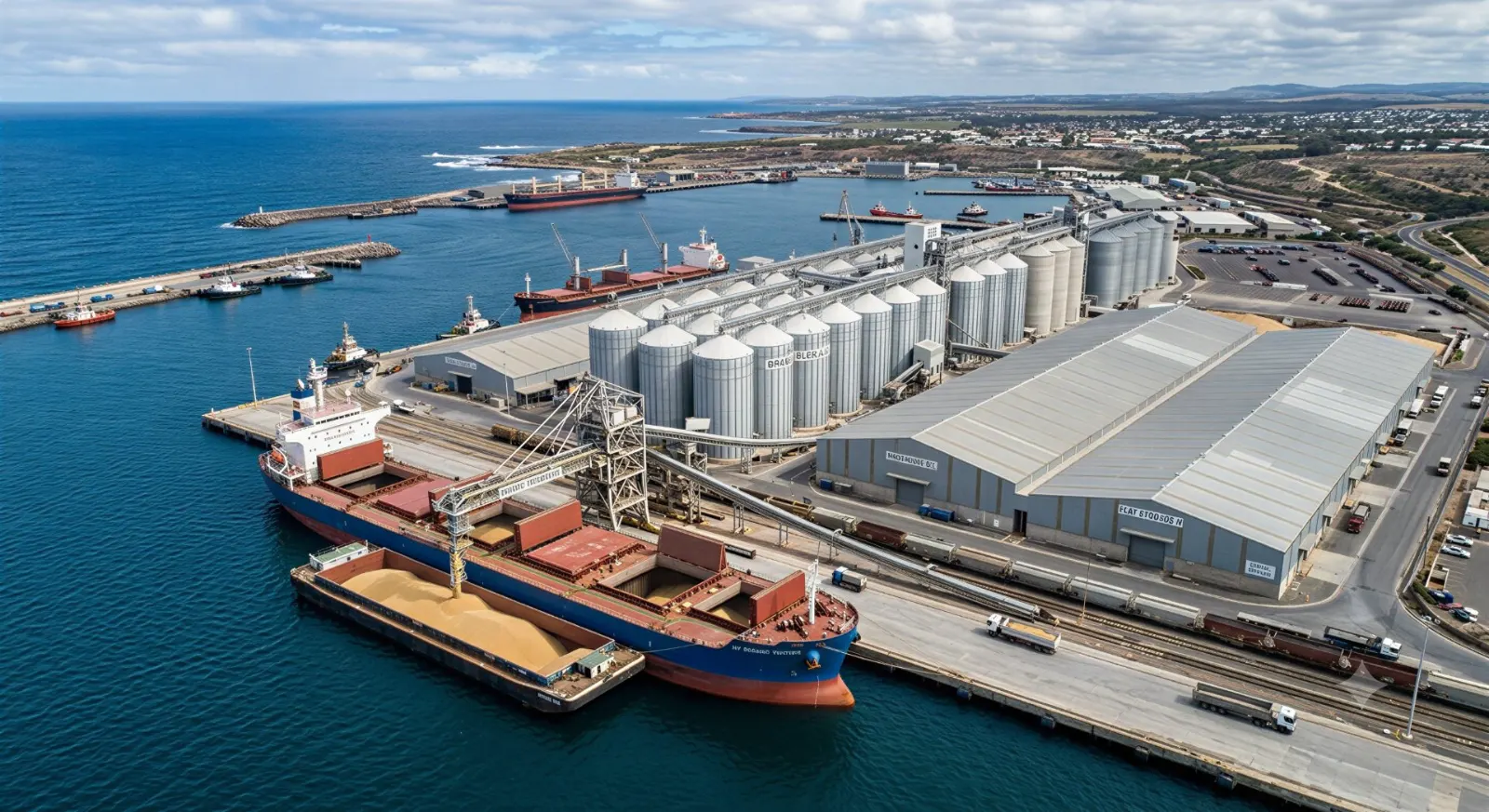
Every terminal repeats the same handful of drops. Select a point on the terminal to see what dust does there — and what the DustCone changes.

Aerial view of a bulk grain terminal showing ship, truck, warehouse and silo transfer points
Beyond dust

A mixed pile holds more than a sorted one.

Free fall Sorted, and looser

Fines separate on the way down, drift off as dust and settle on the surface. The voids between coarse particles stay open.

DustCone column Mixed, and denser

The stream arrives still mixed, so fines land among the coarse particles and fill the voids. Same tonnage, less space.

When material falls freely into a shed, it sorts itself: the coarse grain lands in the middle, the fines drift out to the surface. Those fines are no longer filling the gaps between the coarse particles — so the pile takes up more room than the same tonnage needs to, and reclaims unevenly from top to core. Once sorted, a pile stays that way; it does not remix on its own.

A DustCone delivers the material as one consolidated column, so it arrives at the pile still mixed. That means a denser, more uniform pile from the same shed and the same material — a second reason to fit one, alongside the dust.

An honest note

We are not going to quote you a percentage. The mechanism is well established in bulk solids handling, and we have seen it at our own installations — but we have not yet completed an instrumented before-and-after measurement, so any number we published would be marketing rather than data.

If you run a flat store or terminal and would like to measure it properly with us, we offer favourable terms on the equipment for a documented study.

Talk to us about a field study

Materials

Six material families. The same physics.

Cone angle, wall material and discharge geometry change with the product — the working principle does not.

Maize grain held in cupped hands over a jute sack
01

Grain

Wheat, maize, barley, paddy, soybeans and meals

Every free-fall drop sheds fines and broken grains as airborne dust — lost product, respiratory exposure, and an explosion hazard in enclosed storage.

  • Recovers fines back into the cargo instead of the air
  • Reduces combustible dust concentration in sheds and silos
  • Food-grade SS304 / SS316L builds available
Granular fertiliser held in a hand beside a seedling
02

Fertiliser

Urea, DAP, potash and granular blends

Fertiliser dust is product loss you can price per tonne — and a corrosive housekeeping burden across every surface it settles on.

  • Keeps high-value granules in the load
  • Cuts washdown cycles and corrosion on steelwork
  • Corrosion-resistant SS304 / SS316L construction
Fine white soda ash powder
03

Soda Ash

Dense and light sodium carbonate

A fine, alkaline powder that becomes airborne at the slightest disturbance — irritating to airways and eyes, and quick to migrate across a terminal.

  • Contains ultra-fine powder within the falling stream
  • No air movement introduced at the transfer point
  • Steeper cone variants for cohesive flow
Yellow granular sulfur
04

Sulfur

Granular and formed sulfur

Generates combustible dust with a notoriously low ignition energy. Every uncontrolled drop raises the airborne concentration you are trying to keep down.

  • Purely mechanical — no electrics in the hazardous zone
  • Lowers suspended dust concentration at the source
  • Spark-conscious material selection on request
Piles of silica sand and mineral aggregate
05

Mining & Minerals

Silica sand, limestone, ores and concentrates

Abrasive materials at high tonnages, where visible dust means product loss, silica exposure and community complaints.

  • Hardox and polyurea-lined builds for abrasion
  • Cuts respirable silica at the loading point
  • Sized for terminal-scale throughput
Wood pellets held in cupped hands
06

Wood Pellets

Densified biomass pellets

Pellets abrade against every surface they touch, and each drop turns a fraction of the cargo into fines — combustible dust in an enclosed store, and tonnage that never reaches the boiler.

  • Gentler, decelerated flow creates fewer fines
  • Lowers combustible dust load in sheds and silos
  • Keeps pellet durability within spec on transfer

Handling something not listed — cohesive, damp, high-friction or unusually abrasive? Send us the material and flow rate; we will tell you what it needs.

Tell us about your transfer point.

Flow rate, bulk density, particle size — we'll come back with your engineered sizing within a few working days.

Request sizing